Insights · 28 September 2026
Europe's electric cars run on Chinese know-how.
Europe wants its own battery industry. The machines, the process knowledge and much of the capacity to build it come from China.
Europe wants to build its own electric cars with its own batteries. To do that, it needs cell factories. And to build cell factories, it increasingly turns to China – for machines, for process knowledge and for partners.
This is not a political statement. It is what the order books and the factory floors show.
Where the experience sits
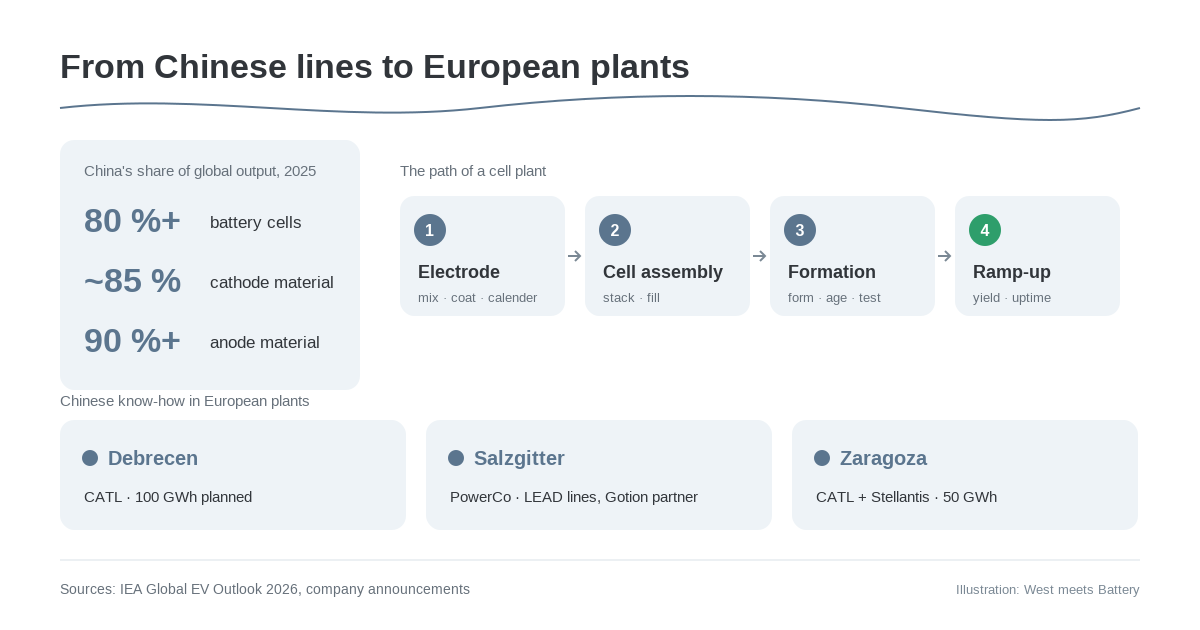
China made over 80 % of the world’s battery cells in 2025, according to the International Energy Agency (IEA). It also produced about 85 % of cathode material and more than 90 % of anode material.
That volume matters for one reason: learning. Every gigawatt-hour produced teaches a factory something about yield, scrap and uptime. No other country has run cell plants at that scale, for that long, across as many chemistries.
The IEA adds a telling detail. Most cell production outside China, in Europe and the US, is done by companies headquartered in Asia.
The machines come from China
A cell factory is a chain of precise machines. Electrodes are mixed, coated, dried and calendered. Cells are stacked or wound, filled with electrolyte, formed and aged. Each step decides the yield of the next.
Chinese machine builders now supply full lines for these steps. When Volkswagen chose equipment for its first gigafactory in Salzgitter in 2022, it picked Chinese supplier LEAD. LEAD delivered more than 65 % of the equipment, from calendering to formation and line logistics.
PowerCo started cell production in Salzgitter in December 2025. Its technology partner is Gotion, a Chinese cell maker in which Volkswagen holds about a quarter of the shares. Gotion advised on factory layout, machinery and processes.
Chinese cell makers build in Europe
- Hungary: CATL began trial cell production in Debrecen in September 2026. The plant is planned for 100 GWh and will be CATL’s largest outside China. CATL already makes cells in Germany, near Erfurt.
- Spain: CATL and Stellantis are building a 50 GWh LFP plant near Zaragoza. Gotion and PowerCo agreed in September 2026 to run a 29.1 GWh cell plant in Sagunto together.
- Slovakia and Morocco: The same Gotion–PowerCo agreement adds an 8.4 GWh cell plant in Slovakia and an LFP cathode plant in Morocco.
European carmakers are no longer only buying Chinese cells. They are inviting Chinese partners to run the factories with them.
Machines alone are not enough
Northvolt shows the other side. The Swedish start-up raised around US$14 billion and also bought its key production lines from LEAD. Yet it struggled to ramp up. BMW cancelled a US$2 billion order in 2024, and Northvolt filed for bankruptcy protection that November.
The lesson is simple. The same machines produce very different results in different hands. Yield comes from people who have run these lines before – and from close work between the plant team and the machine builder.
What stays complicated
Know-how does not always travel freely. In July 2025 China put several LFP cathode and lithium-processing technologies on its export-restriction list. Transfers abroad now need a licence.
Europe sets conditions too. From 18 February 2027 the EU Battery Regulation requires a digital battery passport for EV and industrial batteries above 2 kWh. Carbon footprint, due diligence and traceability must be documented. Every Chinese plant and every Chinese machine in Europe has to fit into that framework.
What this means for Chinese battery and equipment companies
Sell the ramp-up, not only the machine. European buyers remember Northvolt. They want proof of yield, a commissioning plan and engineers on site.
Staff the site early. Installation, commissioning and acceptance need Chinese specialists who can work with a European plant team, in English or German, under European safety rules.
Prepare European documents. CE marking, machinery safety, factory acceptance tests and battery passport data must be ready before the first line ships.
Plan for the long run. Service, spare parts and local staff decide the second order, not the first.
If you supply machines or cells to a European battery plant, we can help you find the projects, prepare the bid and support the ramp-up on site.
Sources
- IEA: Global EV Outlook 2026 – manufacturing and trade
- Green Car Congress: Volkswagen selects LEAD for European gigafactory equipment (Jun 2022)
- Volkswagen Group: Volkswagen and Gotion team up on cell production in Germany
- electrive: PowerCo starts cell production in Salzgitter (Dec 2025)
- CnEVPost: CATL begins trial production in Hungary (Sep 2026)
- electrive: CATL and Stellantis start construction in Spain (Nov 2025)
- electrive: Volkswagen and Gotion agree three joint ventures (Sep 2026)
- Latitude Media: What happened at Northvolt?
- MERICS: Chinese restrictions on battery technology exports
- Switzerland Global Enterprise: EU battery passport from February 2027