Insights · 28 September 2026
Spain shows where Europe's power is heading.
Wind and solar now out-produce fossil fuels in the EU. Spain leads the way – with Chinese hardware and, increasingly, Chinese factories on Spanish soil.
In 2025 wind and solar produced more electricity in the EU than fossil fuels. It was the first time on record. Spain is the clearest example of what that change means for prices, industry and investment.
Much of the hardware behind it comes from China. More and more of it will soon be made in Europe, by Chinese companies.
Europe crossed a line in 2025
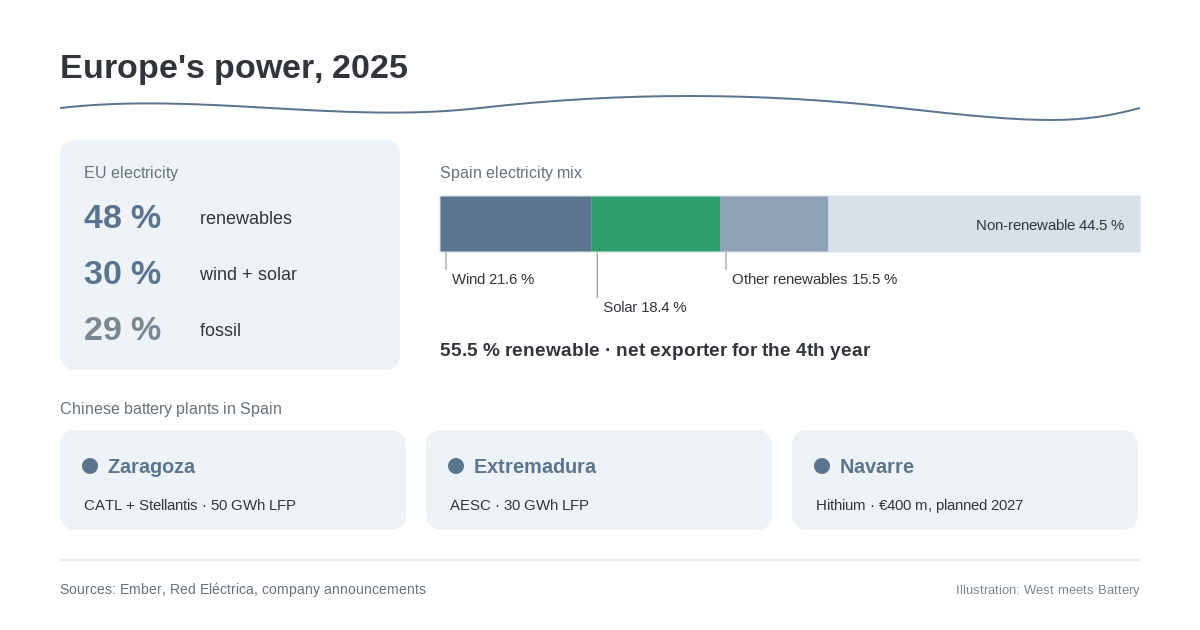
Renewables supplied 48 % of EU electricity in 2025, according to the think tank Ember. Wind and solar alone reached 30 %, against 29 % for fossil power. Coal fell to a historic low of 9.2 %.
Solar grew fastest. It produced 369 TWh, 13 % of EU electricity and 20 % more than a year earlier. In 14 of the 27 member states, wind and solar now generate more than fossil fuels.
The direction is set in law. The revised Renewable Energy Directive requires at least 42.5 % renewables in the EU’s total energy use by 2030.
Spain: the success case
More than half of Spain’s power is renewable. Renewables produced 55.5 % of Spain’s electricity in 2025, according to grid operator Red Eléctrica. Wind was the largest single source for the third year running, at 21.6 %. Solar followed with 18.4 %.
Solar is now the biggest block of capacity. Spain has nearly 50 GW of solar PV installed. Almost 10 GW of new solar and wind came online in 2025 alone. Total capacity reached 142.5 GW.
Cheaper power. In the first half of 2025, Spanish wholesale prices were 32 % below the EU average. Gas set the power price in only 19 % of hours, down from 75 % in 2019. That is a real advantage for energy-intensive industry.
Exports. Spain was a net exporter of electricity for the fourth year in a row in 2025.
The lesson from the blackout
On 28 April 2025 Spain and Portugal lost power almost completely. The final report of ENTSO-E, the European grid operators’ association, found several causes. They included oscillations, gaps in voltage and reactive-power control, and generators disconnecting in quick succession.
The lesson is not “fewer renewables”. It is “more control”. Grids with a high share of wind and solar need storage, voltage support and better coordination. Spain is acting on this. In 2026 it launched a capacity market, approved by the European Commission, that also pays battery storage.
China’s role: from supplier to investor
Hardware. China supplied 98 % of the solar panels the EU imported in 2024, according to Eurostat. Its share of imported wind turbines rose to 43 %. Without Chinese modules, Europe’s solar build-out would have been slower and more expensive.
Factories in Spain. Chinese battery makers are now building in Spain:
- Zaragoza: CATL and Stellantis broke ground in November 2025 on a 50 GWh LFP cell plant. The 50:50 joint venture invests up to €4.1 billion and received more than €300 million in EU funding.
- Extremadura: AESC started building a 30 GWh LFP battery plant in Navalmoral de la Mata in July 2024.
- Navarre: Hithium signed a €400 million agreement in April 2026 for a factory with around 700 jobs, planned for 2027.
Envision also announced a US$1 billion green hydrogen and electrolyser park in Spain in 2024.
Politics. At their July 2025 summit, the EU and China issued a joint climate statement. They committed to accelerate renewable deployment worldwide and to cooperate on green and low-carbon technologies.
What stays complicated
Cooperation comes with conditions. Since 30 December 2025 the EU’s Net-Zero Industry Act requires “resilience” criteria in public renewable auctions. They apply to at least 30 % of auctioned capacity, or 6 GW a year. Where one non-EU country supplies more than half of EU demand for a technology, bids that diversify supply gain an advantage.
In practice, a Chinese product alone is no longer enough to win. Local production, European partners and transparent supply chains increasingly decide.
What this means for Chinese battery and equipment companies
Follow the storage demand. Spain’s grid needs batteries, voltage support and control systems. Its capacity market creates a revenue stream for storage projects.
Build or partner locally. The Zaragoza, Extremadura and Navarre projects show the model: European partner, EU funding, local jobs. Auction rules now reward it.
Prepare the documents early. European buyers ask for grid-code compliance, cyber-security evidence and supply-chain transparency. For batteries, the EU Battery Regulation adds carbon-footprint and due-diligence duties.
Bring the equipment, and the people who can ramp it up. Every new European cell plant needs Chinese machines installed, commissioned and accepted on time.
If you plan to supply Spain’s storage build-out or a new European battery plant, we can help you find the projects and prepare the bid.
Sources
- Ember: European Electricity Review 2026
- European Commission: Renewable Energy Directive – targets and rules
- Red Eléctrica: The Spanish electricity system in 2025
- Ember: Decoupled – how Spain cut the link between gas and power prices
- ENTSO-E: Expert panel final report on the 28 April 2025 blackout
- Energy-Storage.News: EU approves Spain’s capacity market
- Eurostat: EU imports of green energy products in 2024
- electrive: CATL and Stellantis start construction in Spain (Nov 2025)
- Just Auto: AESC breaks ground in Spain (Jul 2024)
- Energy-Storage.News: Hithium signs €400 million Spain agreement (Apr 2026)
- ICEX Invest in Spain: Envision electrolyser plant in Spain
- Council of the EU: Joint EU–China press statement on climate (Jul 2025)
- Covington Global Policy Watch: NZIA non-price criteria in renewable auctions