Insights · 26 September 2026
The yuan is building new rails to Europe.
Digital yuan, CIPS and yuan-priced gold will not replace the dollar soon. They do make it easier to buy and sell in yuan between China and Europe.
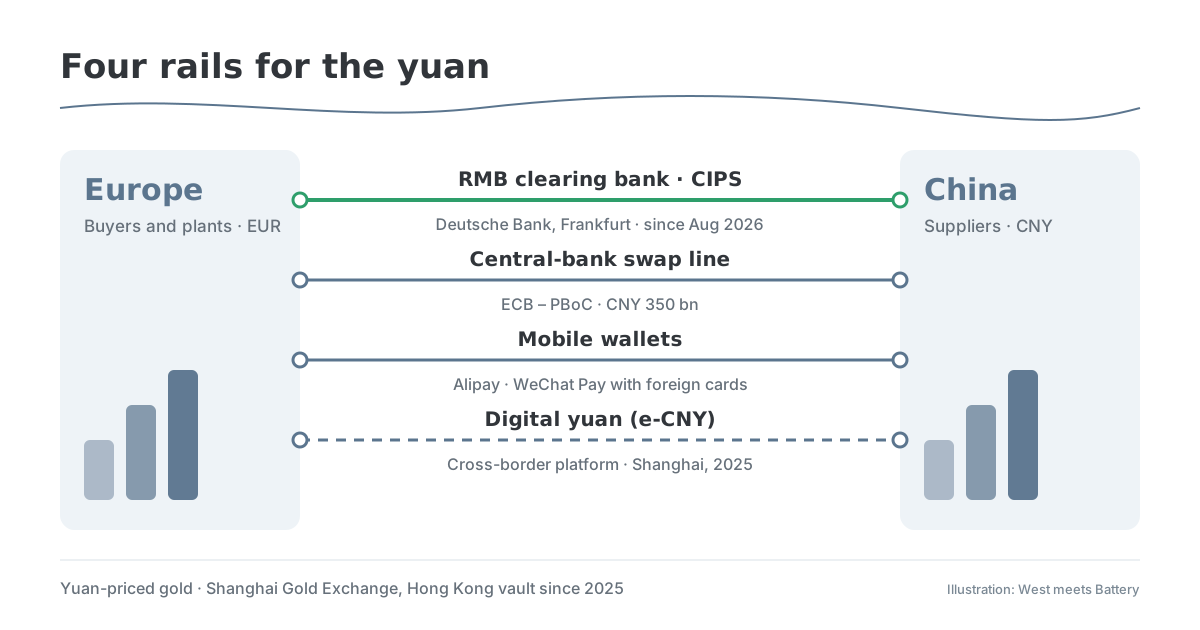
The US dollar still settles most of the world’s trade. That is not changing this year. But China is building payment rails that do not depend on it, and some of them now end in Europe.
For a Chinese battery supplier with European customers, this is not a question of geopolitics. It is a question of invoicing, bank fees and currency risk.
Three developments behind the headlines
The digital yuan goes cross-border. The e-CNY is the People’s Bank of China’s (PBoC) central-bank digital currency. In September 2025 the PBoC opened an e-CNY international operations centre in Shanghai with a cross-border payment platform. Since 1 January 2026, e-CNY held in bank wallets counts as a deposit and can earn interest. In June 2026, 26 financial institutions signed up as direct participants in its cross-border service.
CIPS grows next to SWIFT. CIPS is China’s Cross-Border Interbank Payment System for yuan payments. It processed about CNY 175 trillion in 2024, 43 % more than a year earlier. It had around 1,700 participating institutions in 2025, and 17 % of its indirect participants are in Europe. CIPS works alongside SWIFT; it does not replace it.
Gold, priced in yuan. In June 2025 the Shanghai Gold Exchange opened its first vault outside the mainland, in Hong Kong. It trades yuan-priced gold contracts. This does not make the yuan a gold-backed currency. It gives holders of yuan one more place to put it.
What the numbers say today
In June 2026 the yuan was the fifth most used currency in global payments on SWIFT, with a 3.10 % share. In trade finance – letters of credit and collections – it ranked second, with 8.00 %.
The gap to the dollar in payments remains large. The trade-finance figure is the one that matters for manufacturers. It shows the yuan is already a normal currency for paying for goods.
Where doing business in yuan in Europe gets easier
A German bank now clears yuan. In August 2026 the PBoC named Deutsche Bank in Frankfurt as a renminbi clearing bank for Europe. Before, all European clearing banks were branches of Chinese banks. European companies can now settle yuan payments through a bank supervised by the ECB and the German regulator.
The central banks keep a safety net. The ECB and the PBoC renewed their swap line in September 2025, up to CNY 350 billion. It runs until October 2028. It lets euro-area banks get yuan if liquidity suddenly runs short.
Serbia: yuan for trade and investment. Bank of China Serbia has been the country’s yuan clearing bank since December 2023. A China–Serbia free trade agreement took effect in July 2024. In May 2026 the two central banks tripled their swap line to CNY 5 billion. Its stated purpose is to support trade and investment by companies in both countries.
Hungary borrows in yuan. In July 2025 Hungary sold a CNY 5 billion “panda bond” on China’s domestic market. It was the country’s largest yuan bond to date. An EU state now funds part of its budget in yuan.
Western visitors can pay the Chinese way. Visitors to China can link a Visa or Mastercard card to Alipay or WeChat Pay. Limits were raised to USD 5,000 per payment and USD 50,000 a year. European buyers visiting suppliers can now pay for taxis, meals and hotels without cash.
What stays the same
Most European buyers budget, tender and pay in euro. Many Chinese exporters still quote in US dollars. The yuan is not freely convertible, and capital controls still apply. The e-CNY is not a payment method for European companies today.
So the practical change is modest but real. The yuan is becoming one more option on the table – not the default.
What this means for Chinese battery companies in Europe
Offer a currency choice, not a currency lecture. Quote in euro by default. Offer yuan where a buyer has yuan income or a Chinese parent. Some buyers will value the option; few will ask for it.
Check the buyer’s bank before the contract. Ask whether their bank can receive and pay yuan, and at what cost. A clearing bank in Frankfurt makes this answer easier than it was a year ago.
Price the currency risk openly. A euro quote moves your yuan margin. A yuan quote moves the buyer’s budget. Agree in the contract who carries the risk, for how long, and at which reference rate.
Screen payments as carefully as products. Sanctions and export-control checks apply to banks and payment routes too. Choose a route your buyer’s compliance team will approve.
Currency choice rarely wins a tender. A payment problem can still lose one. If you are preparing your first European contract, we can help you structure it so the buyer says yes.
Sources
- People’s Bank of China via Caixin: e-CNY international operations centre, Shanghai (Sep 2025)
- Chinese government: e-CNY as interest-bearing deposit money from 1 January 2026
- CoinGeek: 26 institutions join cross-border e-CNY service (Jun 2026)
- FXC Intelligence: CIPS volumes and participants
- South China Morning Post: Shanghai Gold Exchange opens Hong Kong vault (Jun 2025)
- SWIFT Global Currency Tracker, reported by Trade Treasury Payments: June 2026 data
- Central Banking: PBoC appoints Deutsche Bank as renminbi clearing bank for Europe (Aug 2026)
- European Central Bank: euro–renminbi swap line extended (Sep 2025)
- Belt and Road Portal: Bank of China Serbia authorised as RMB clearing bank (Dec 2023)
- Global Times: China and Serbia triple their currency swap (May 2026)
- Hungarian Conservative: Hungary’s CNY 5 billion panda bond (Jul 2025)
- Chinese government: payment guide for overseas visitors